
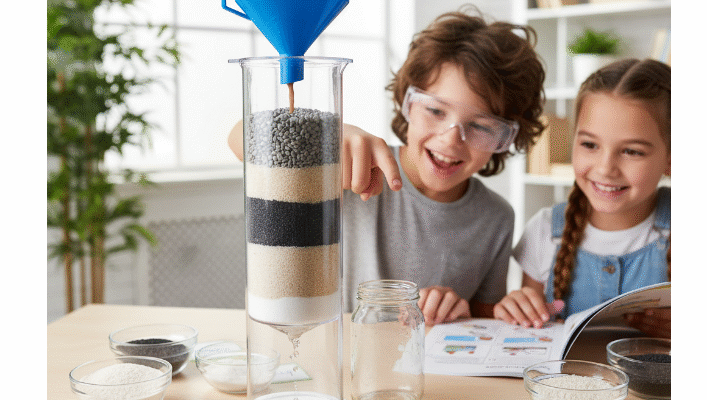
Are you looking for a creative and interactive science project that puts classroom learning into practice for real-world environmental issues? We have the answer in our do-it-yourself Water Filtration Kit, which we designed to get students involved in hands-on problem-solving and critical thinking. This full-scale educational science experiment kit that we put together allows young scientists to build a fully functional multi-layer water filter at home or in the classroom. Through the use of basic natural materials like sand, gravel, charcoal, and cotton, which they put together themselves, students go beyond reading about pure water; they create it out of a sample of dirty water. This unique hands-on approach is at the base of what we do in STEM learning kits, which also includes the element of Authenticity in the work we present.
The Science of Water Purification for Students
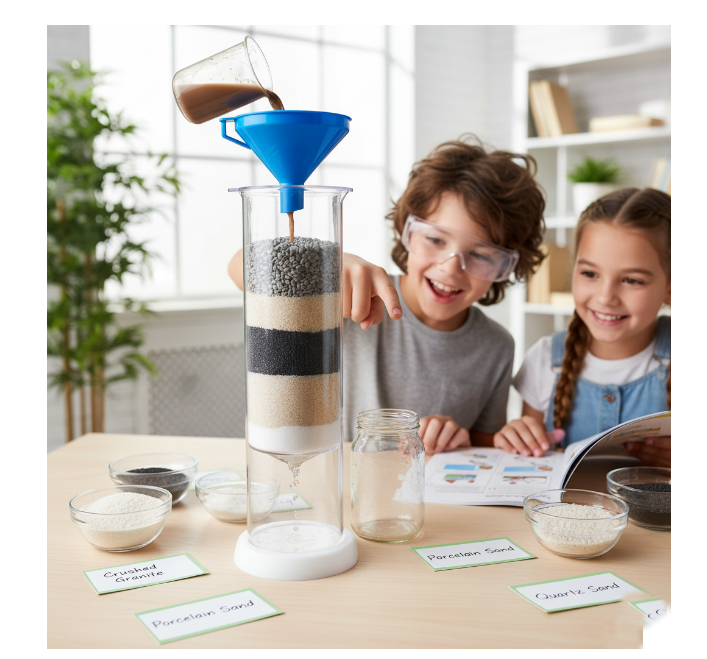
Through the use of natural materials, which act as filters, we have designed this do-it-yourself water filtration kit, thereby transforming large-scale industrial processes into a simple, easy-to-follow vertical column model. Crucially, each layer of the filter, including the coarse gravel, fine sand, and activated carbon, has a separate role in the water purification process. Consequently, it is on this layering that we put a lot of focus, since it is the base of the filtration science. Furthermore, we have structured our content to be very in-depth and informative, which fulfills the users’ search for information on how these science stem kits work and not just what they are, by going into detail about each component’s function. Ultimately, these science experiment kits provide unmatched educational value.
The great thing about our multi-layer design is that it has successively finer filtering media, which we present in our stem experiment kits.
- Crushed Granite/Coarse Gravel (First Line of Defense): Responsible for collecting large debris like leaves, twigs, and large sediment particles.
- Porcelain Sand/Fine Sand: Catches mid-size particles like silt and fine dirt, improving water clarity.
- Activated Carbon (The Star): Uses adsorption to chemically bond with tiny impurities, remove organic contaminants, residual chlorine, and eliminate bad smells/tastes.
- Quartz Sand/Filter Paper: Serves as a final touch-up, catching loose carbon or very fine particles.
This practical demo puts into play the value of materials science in environmental solutions.
Active Problem Solving: Environmental Issues & Clean Water
The issue of clean potable water is a vital, active problem. To address this, through hands-on experience with this science experiment kit, students develop expertise in basic civil engineering and environmental health. Specifically, students study flocculation, sedimentation, and filtration, which they see as a scaled-down version of a very large and important infrastructure system. In essence, they see their do-it-yourself water filtration project as a microcosm of a bigger problem that is very present in our society. Consequently, by successfully using the stem science kits to clarify the muddy water, they gain confidence and a practical takeaway of how worldwide communities use these layering techniques.
Important Safety Note: While a science lab kit filter does a great job at removing physical impurities, it does not remove all microscopic pathogens. We must still use boiling or chemical disinfection for true drinking safety.
Improving the Educational Experience with Sagedel Content
Our educational STEM kits are a true model of quality, which we have designed for maximum knowledge transfer. For instance, in them, you will find step-by-step guides that also present extension activities. Consequently, this is what puts our premium STEM water science projects above the rest. Furthermore, we include see-through chambers for observation and a detailed manual, which allows the student to watch the water’s progress through each medium. In doing so, this strengthens the connection between abstract concepts and physical reality. Ultimately, this level of detail increases the authority of the info we present, thereby giving our materials authority that educators and parents can count on. Clearly, our science experiment kits are perfect stem kits for schools
Conclusion: Developing Future Environmental Scientists
The DIY water filtration kit is an investment in a student’s future. First and foremost, it provides a tactile, memorable experience, thereby reinforcing complex scientific concepts. For example, students move from simply understanding how to construct a multi-layer filter to visualizing the critical nature of activated carbon. Ultimately, this STEM water science project is empowering the next generation of environmental image-makers. In conclusion, do not just teach the student science; allow the student to conduct science. Therefore, order an innovative sagedel educational kit today, and turn muddy water into a clear experience around purification.
Follow for more — sagedel
