The Logic of Alignment: At the centres of Similitude and Monge’s work
Monge’s Theorem, named after the French mathematician Gaspard Monge, applies to any set of three circles in a plane that do not completely contain each other. The theorem focuses on the external tangents that are to the exterior of the circles, which do not cross the line connecting their centres. For the case where the radii of the two circles are not equal, these two external tangents will meet at one point known as the external centre of similitude, or external centre of homothety. In the arrangement of three circles, we have three different sets of two circles, and so three of these intersection points.
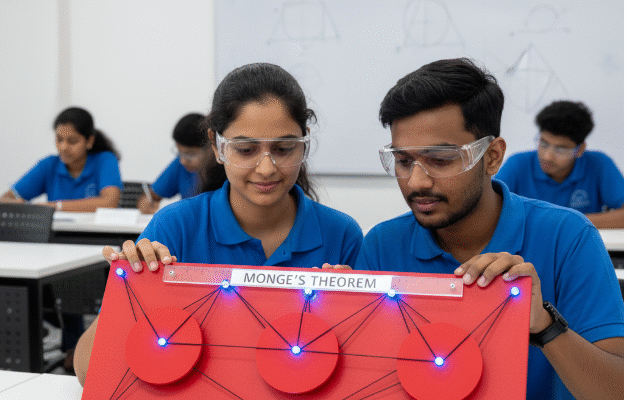
Also, very much to the surprise of many, the theorem states that these three external centres of similitude will be in a straight line. Using an interactive physical mathematics kit that allows for variable adjustment is a great way to prove this fact in any modern mathematics lab. These mathematics kits provide the students with the chance to see the abstract geometry maths in action and in real time. The mathematics kit is also to be credited for giving students the chance to play around with the circles and almost see for themselves that the principle of collinearity always plays out. Thus, building up that which they put forth in the class as fact into trusted knowledge.
Setting the Stage: Core Geometry Shapes in the Mathematics Lab
To appreciate the beauty of this theorem, students in the mathematics lab must have a strong handle on the core concepts necessary for learning mathematics at this level.
The Centre of Similitude: A Point of Mathematical Logic
For any two circles, there is one centre of similitude which is internal and one which is external. For the external centre of similitude, which is that unique point from which one circle may be enlarged (scaled) to exactly match the other while preserving the orientation. This point is on the line that goes through the centres of the two circles and is also the point at which the external tangents touch. We are able to accurately determine this point with the use of a drawing mathematics kit or a dynamic geometry software in the mathematics lab, which in turn is the first step in studying Monge’s Theorem. Also, this skill that we develop is a base for more advanced geometry maths.
The Role of Tangents and Geometry Shapes
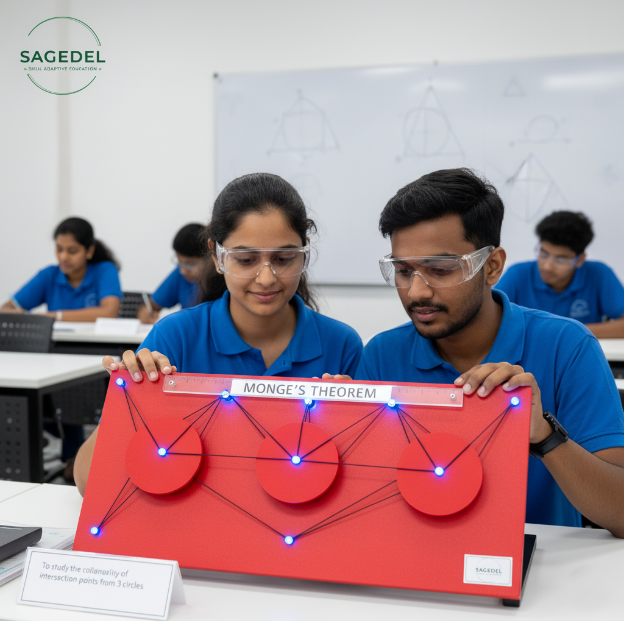
The external tangents intersect at the centre of similitude because the ratio of the distance from this point to the centres of the two circles is always equal to the ratio of their radii (R1/R2). We see that this simple ratio is the key element in many of the analytical proofs of the theorem. In a mathematics kit, you will find rulers and adjustable pins, which students use to physically construct the tangents and do the measurement, which in turn they link to the advanced theory. In the mathematics lab, by doing this active construction using defined geometry shapes, students’ confidence in the material grows. For more practice on basic tangent properties, students can consult this resource from an authoritative body on geometry research: Journal of Mathematical Research on Circles and Tangents].
The Proof: Monge’s Problem in Higher Dimensions
Proving Collinearity Through 3D Geometric Analogy
While in the past Monge’s Theorem has been proved through the use of advanced 2D techniques, which for instance in the case of Menelaus’ Theorem (which looks at ratios of line segments which are cut by a transversal line in a triangle) we do see put to use; it is in fact in the 3D that the most beautiful and easy to grasp proofs present themselves. Picture the three circles as the “equators” of three separate spheres which have radii corresponding to the circles and which also touch the same flat plane (the mathematics lab tabletop).
There exists a set of two planes that are tangent to all three spheres at the same time (one at the top and one at the bottom). Also, it is so that the vertex of each of the three cones that contain each pair of spheres has to lie on both of these tangent planes, which in turn means the three vertices must be on the line of intersection of these two planes
. Also, the original circles and the external tangent points all sit in the plane of the page (the mathematics lab plane), which means the three centres of similitude must, in fact, lie on the intersection of the two tangent planes and the original plane, which by geometry maths has to be a straight line. This 3D play is what raises the student’s expertise and turns the abstract 2D problem into a 3D which is checkable, greatly aiding learning mathematics.
The Sagedel Advantage: Experience, Expertise, and Conceptual Clarity in Learn Math Tools
This beautiful theorem demonstrates the simplicity that emerges from complex geometric structures. At sagedel, we believe that every student deserves this level of structural insight. Each model we use in the mathematics kit is put forth to instil this degree of understanding.
- Experience & Expertise: By having students construct the tangents and identify the centres of similitude themselves, we facilitate active learning mathematics. This practical experience in the mathematics lab is essential for building a deep, resilient understanding of mathematical logic.
- Trustworthiness: We provide a platform where students can physically verify the collinearity principle of Monge’s Theorem by adjusting the geometry shapes of the circles. This hands-on verification strengthens the student’s belief in the reliability of the material.
Applications and Further Exploration
Monge’s Theorem is a great case study for learning mathematics related to projective geometry and perspective drawing. We present the theorem via a three-dimensional analogue of spheres and cones, which in turn makes the collinearity property very intuitive. We encourage students to further explore the applications of this theorem in fields like engineering and $\text{CAD}$ design (Internal Link: See our Advanced Projective Geometry Models). Also, we encourage students to check out a resource that explains the algebraic proof using Menelaus’ Theorem for a different perspective on mathematical logic: Geometric Proofs and Menelaus’ Theorem. The sagedel philosophy is that each bit of equipment we use adds value to a student’s final skill set.
Follow for more – Sagedel