Description
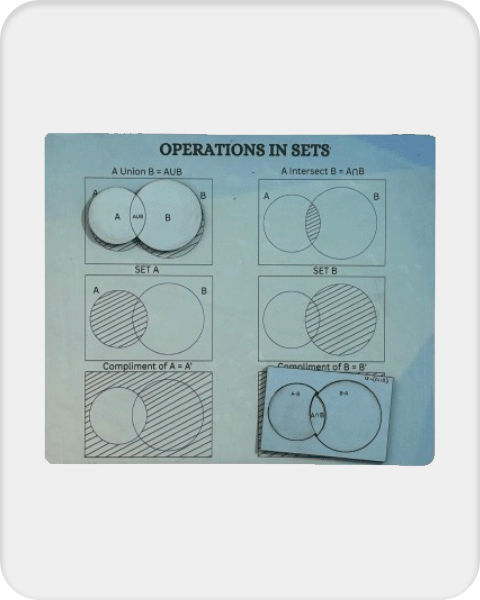
Start mastering the principles of set theory and mathematical logic today with the all-in-one Operations In Sets Kit from Sagedel. This essential visual aid is perfectly designed for middle school, high school, and introductory college math classrooms. It provides every component needed to physically model union, intersection, difference, and complement right out of the box. Furthermore, this durable model makes abstract set relationships intuitive and easy to demonstrate.
Key Components and Design Features
This meticulously assembled kit ensures a genuine, practical, and comprehensive learning experience.
Venn Diagram Base: Features a clear, stable board with adjustable, interlocking rings or movable magnetic shapes representing two or three sets.
Movable Elements: Includes colored tokens or magnetic discs to represent elements, allowing students to physically move them between sets and the universal set.
Color-Coded Shading: Transparent or colored overlays for accurately highlighting the areas representing the result of a set operation (e.g., the intersection).
Universal Set Frame: A clearly defined boundary representing the universal set ($U$).
Detailed instructional guide with set notation, definitions, and word problems to model.
Learning Outcomes and Educational Value
This Operations In Sets Kit is more than just a diagram; it is a gateway to deeply understanding mathematical logic, probability, and database design. Because we designed this kit to be an engaging, hands-on learning tool, it is ideal for students who struggle with abstract notation.
Practical Applications and Study Skills
The Operations In Sets Kit is a vital tool for improving visual reasoning and problem-solving in probability. For example, students can use the model to physically determine the number of elements in the union of two sets, verifying the inclusion-exclusion principle.
Students can practice translating set notation ($\cup$, $\cap$, $A’$, $A \setminus B$) into visual models.
They observe and understand how elements are shared or excluded during different operations.
Therefore, users gain practical knowledge of fundamental set theory, Venn diagrams, and logical reasoning, preparing them for advanced statistics, computer science, and logic courses.
Order your Operations In Sets Kit today and bring mathematical logic to life!