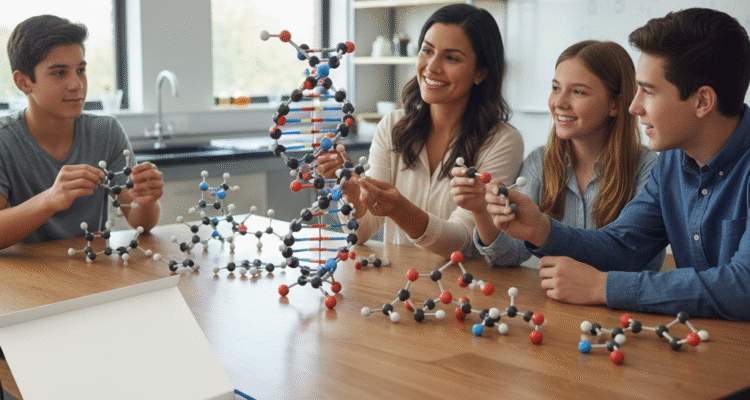
Molecular Models are for educators what textbooks are for the rest of us; they fill in the void left by 2D representations of 3D chemical structures. We see in students the point at which they either become passionate about or are put off by abstract topics like molecular geometry, bond angles, atomic structure and chirality.
As a teacher, what you bring to the table in terms of hands-on experience is what will, in large part, determine how well your students come to understand the material. This in-depth guide is your go-to resource that details the many benefits of these tools, their practical uses, and best practices for including them in the classroom, thus giving each student the chance to literally grasp chemistry.
Chemistry’s Transformative Role in Practical Study
In the past, we saw that traditional teaching methods, which included the use of chalkboards, whiteboards, or digital slides, mostly flattened the world of atoms and molecules. We found this to be a great issue when students studied concepts that are very spatial in nature. What we did find is that molecular model kits, which in turn stimulated spatial and tactile learning—a very different pedagogy—improved info retention and problem-solving skills out in fields like organic chemistry. This form of active engagement goes beyond simple memorisation, which in turn builds a robust conceptual framework that benefits students in their more advanced science studies. These kits are essential educational kits for students and a cornerstone of effective chemistry lab instruction.
Visualising the Abstract: From Lewis Structures to 3D Reality
One issue that we see time and again with chemistry students is that they have difficulty visualising the transition from a Lewis dot diagram out into the 3D forms of compounds such as glucose or cyclohexane. A great way to address this is through the use of high-quality molecular models. As students put together the colour-coded atoms, which we use to represent different elements (for instance, black for carbon, white for hydrogen, and red for oxygen), they are in the process of building out their own knowledge of valence bonding and stoichiometry.
The physical nature of these science STEM kits—the pre-drilled out atoms for particular bond angles (for example, $109.5^\circ$ in a tetrahedral carbon)—does, in fact, give students a practical sense of VSEPR theory (Valence Shell Electron Pair Repulsion).
We are seeing this as the gold standard of experiential learning, which takes students beyond just memorisation into a mode of discovery. The hands-on element also makes the material more real and the experience more enjoyable, which in turn increases student engagement and curiosity. This hands-on method makes these some of the best science experiments kits available.
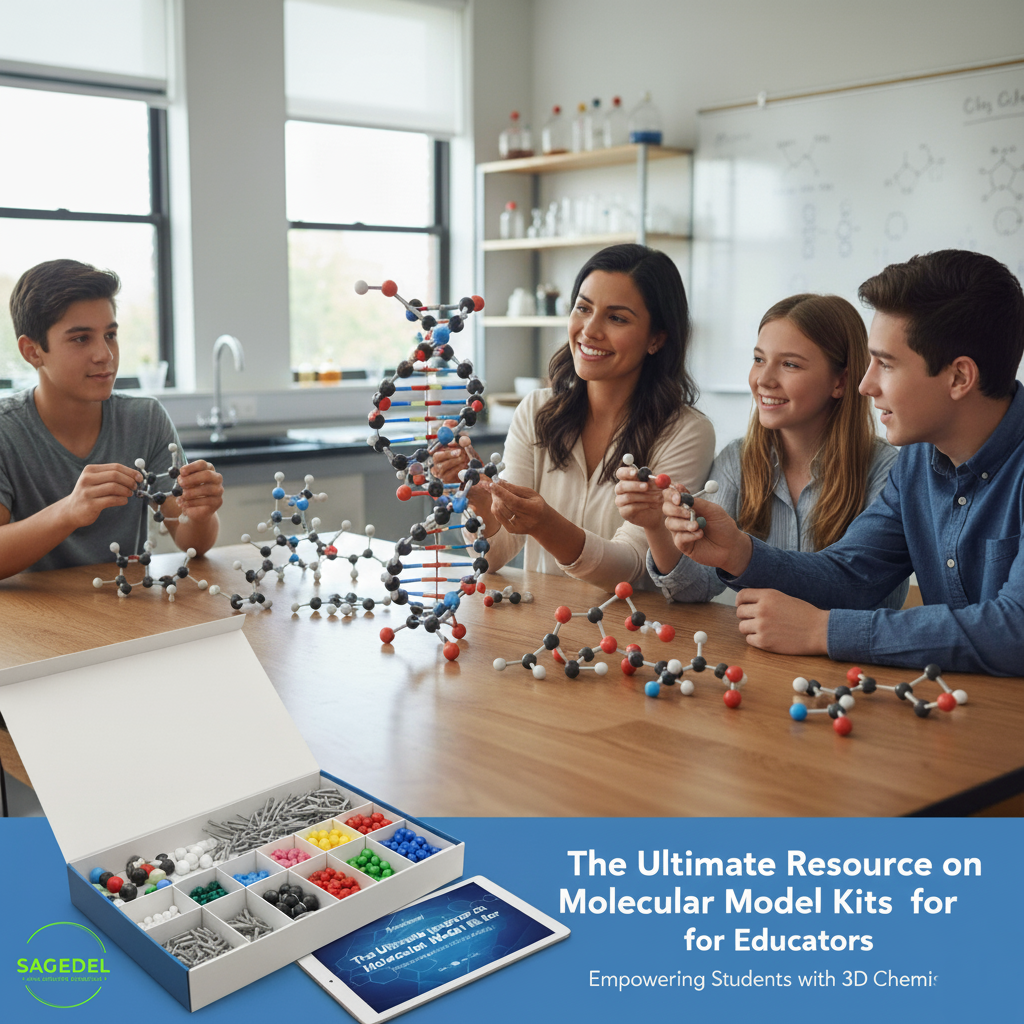
Main Ideas Learned from the Use of Molecular Models
Molecular Models for Educators, we have put together a very comprehensive set of tools which cover the range from basic general chemistry through to advanced organic material. We have broken down the key concepts that these models do an excellent job teaching:
- Molecular Geometry and Polarity: Students can put together and look at the shapes of a linear, trigonal planar, tetrahedral, bent, and trigonal pyramidal type. As they construct the models for the molecules’ symmetry, they also determine the polarity. For example, building a nonpolar $\text{CH}_4$ and a polar $\text{NH}_3$, which one puts together in 3D form, does what a book drawing cannot do. This reinforces understanding of Atomic and molecular structure.
- Isomerism and Stereochemistry: This is where models truly shine. Topics which trouble many students, like that of cis and trans isomers, enantiomers, and diastereomers, become very clear when the student puts together two models and tries to superimpose them. Being able to rotate a chair conformation of cyclohexane or manipulate a chiral centre in 3D changes the story of stereochemistry from that of a nightmare to an engaging puzzle. The simple action of identifying non-superimposable mirror images breaks down the concept of chirality.
- Furthermore, regarding Hybridisation and Orbital Overlap, educators may present models of single, double, and triple bonds, which we often represent with different length connectors (short for single, flexible for multiple bonds). Crucially, the difference between a single rotatable bond and a rigid double bond provides the framework to understand $\text{sp}^3$, $\text{sp}^2$, and $\text{sp}$ hybridisation and the resulting structural flexibility (or lack of it). Consequently, this hands-on understanding is key to mastering Atomic and molecular structure.
Key Features to Look For: Ball-and-Stick vs. Space-Filling Models
Choosing which kit to use is of the utmost importance for effective teaching. The market presents a range of options, which all have their own benefits. As you make your decision, note these key features:
| Model Type | Pros | Cons |
| Ball-and-Stick Models (Most Common) | Great for depicting bond angles, hybridisation, and connectivity. Very good at visualising the molecular structure. | Doesn’t properly show the size of atoms or the space they take up (electron clouds). |
| Space-Filling Models | Represents the true volume of electron clouds, which in turn gives a better picture of steric hindrance. | Hard to notice the internal bonds and bond angles. Not as flexible for complex structures. |
Durability and Compatibility
Classroom kits are going to be used very much. Therefore, we see to it that we go for robust, durable plastic parts. In fact, many teachers prefer the Sagedel models, which reportedly do very well with their standardised colour coding and easy assembly. This reliability, in turn, gives you longevity and interchangeability of parts. Ultimately, the Sagedel science equipment investment over the long term pays for itself out of reduced replacement costs and maintenance of a consistent teaching environment. As a result, these are excellent science kits for school environments.
Essential Kit Components
In high school and introductory university chemistry, a sufficient set should include:
- Atoms: A large range of colored atoms that are true to the universal standard (black for carbon, red for oxygen, blue for nitrogen). A high number of 4-hole (tetrahedral) carbon atoms is crucial.
- Bonds: Short, stiff bonds represent single bonds and long, flexible bonds for double and triple bonds.
- Speciality Components: Pieces for lone pairs, pi orbitals, and also cyclopropane rings, which are great to use in organic chemistry.
- Storage: A robust partitioned box for the reduction of loss, and which organises the atoms by element, thus saving class time.
E-E-A-T Framework: Founding Expertise with Models that Present Instruction
In the digital age, it is up to the educator to present themselves as authority figures and trusted sources, which they do through real-world experience. Use of molecular model kits allows you to personify your expertise. This focus on practical application highlights science and innovation in the classroom.
- Experience: Guide students in the creation of models for molecules which they encounter in everyday life—caffeine, ethanol, and DNA base pairs. This real-world context at once makes the lesson relevant.
- Expertise: Through explanation of the fine details, which, for instance, compare the rigidity of a double bond to the rotation of a single bond, you demonstrate a great depth of knowledge beyond that of basic definitions.
- Authoritativeness: Standardised and dependable educational science kits that we use in the classroom set the stage as a credible learning environment.
- Trustworthiness: When students see that the models we use (like VSEPR) support the theories, they, in turn, trust the science and, by extension, they trust our teaching.
To that end, include in your instruction references to authoritative sources that will add weight to your point. For example, in the case of molecular compound naming, use the IUPAC Gold Book as a standard.
Best Practices in the Use of Model Kits as a Curriculum Tool
In order to see the greatest results from molecular model kits in the classroom, integration must be a deliberate and well-thought-out process. These practices turn basic chemistry experiments into deep learning opportunities.
- Low-Stakes Practice: Start off the lesson with students immediately building the model of the molecule we are discussing. Use that as a quick formative assessment upon entering class.
- Collaborative Problem Solving: Divide the class into teams that will work with complex molecules or a series of isomers (for example, all structural isomers of $\text{C}_4\text{H}_{10}$). This also promotes communication and teamwork.
- Modelling Reactions: Use models to present chemical reactions, like those of bond breaking and bond formation in a substitution or addition reaction. The models put forth a visual story of the chemical transformation.
For example, see what the Journal of Chemical Education and other academic journals report on this topic.
Follow for more – Sagedel