
In technical fields, we have always had the issue of going from abstract theory to practical application. Students may learn all the symbols on a component diagram by heart in vocational education, but still face a mess of tangled wires when opening a real washing machine or refrigerator. What is needed in vocational education is a bridge, and that bridge is what large-format schematic models provide.
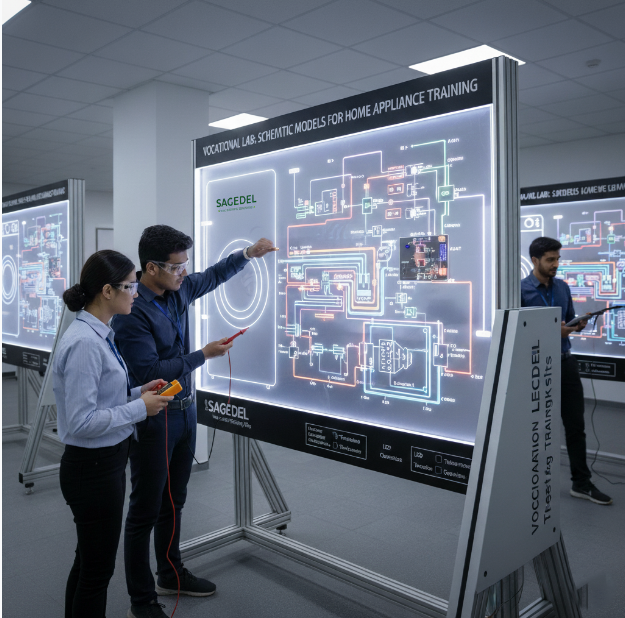
They are not simple posters; these are functional, large-scale representations of the internal circuitry and mechanisms of what we find in home appliances like LED TVs, microwaves, and washing machines. They are the stars of the show in today’s best vocational training kits, which also include traditional blueprints.
What they do is provide a clear, colour-coded, and very accessible look at complex internal systems, which in turn immediately raises student confidence and puts them on the fast track to technical skill and authority. Utilizing a dedicated vocational lab is the ideal environment to harness this tactile learning.
The Sagedel Advantage: Enhancing Vocational Kits with Visual Expertise
In the Sagedel framework, we see learning as a dynamic and very personal process. We present our educational kits, which feature extensive hands-on interaction with the schema boards. We diverge from screen-based simulators, which are 2D in nature, to present physical models that allow students to literally trace paths of current, identify failed components by sight, and use multi-meters on live circuits.
This active participation is the basis of what we do in our vocational lab environments. Take, for instance, the issue of a modern fridge’s defrost circuit; it is almost impossible to trace this out in a small-scale model. But on a large-scale schematic model, the flow is right there, which in turn makes complex issues such as relay control, temperature sensing, and start-up of the compressor easy to see.
For new students to the world of repair and maintenance, these sets of vocational training kits have two functions at once. We begin with the expertise needed in order to properly read and interpret schematic diagrams. A full-scale model will not only display the circuit layout but also present a detailed key to component colour code (as in the case of resistor colour bands) and a common set of symbols for components like LDRs, LEDs, speakers, buzzers, and different types of capacitors. Also, these electricity learning kit models serve to put in faults realistically and to have students diagnose them. In the classroom, we see educators introduce what in practice are common breakdowns, which in turn challenge students to take their theory out into the real world and apply it.
Core Topics of Schematic Models: Bridging Vocational Science and Practice
The key aim of any strong vocational training kit system is to see that students gain practical, transferable skills. In terms of structured models, we see that the results are very much what the industry is looking for:
Grasping the Working Principles through Vocational Lab Experience
Students do not learn just what a washing machine does, but how it accomplishes its tasks. They know the role of the programmer unit, logic gate, the power circuit which controls the drum motor, and the safety cut-offs. Every unit, and every transistor and transformer, has its function explicitly labelled and illustrated on the board. This allows for a synthesis of thinking about a machine: rather than examining the parts of a washing machine in isolation, students gain a contextualized understanding of a complex electromechanical object. This synthesis leads to a more robust educational experience in a vocational lab program, ensuring students are ready for the practical challenges presented by modern stem learning kits.
Safety and Repair Training: Essential Use of Vocational Equipment
Engaging with household appliances usually involves high voltages, so safety is the number one consideration. Utilizing the schematic models in our vocational kits allows students to practice safety procedures with no risks, since they would be working with a model instead of a live enclosed circuit. They will learn where it is safe to take a voltage measurement, as well as how to identify fused circuits and how to isolate components safely.
This establishes huge Trustworthiness and confidence before ever physically working on an appliance. Also, the relationship of textbook theory to practical application is provided every time the student investigates a theoretical voltage at the test points of the model using their actual multimeter. An effective immersion in safety practice is not an option in vocational education. Students are encouraged to seek knowledge from credible resources about safe electrical practices, like the published recommendations of The International Electrotechnical Commission (IEC)].
The Future of Vocational Education: Applying Vocational Mathematics to Smart Systems
Microcontroller Application in Smart Home Devices :- This section presents an overview of how Internet of Things (IoT) principles are adopted by traditional home technology. We aim to get students ready for present as well as future roles in this field. We want to maintain our authority in that field which is very much in flux. Our advanced educational kits are being continually updated to reflect the convergence of electromechanical repair and digital control systems.
Career Paths in Appliance Repair and Maintenance: The Outcome of a Strong Vocational Lab
We also provide detailed guidance on lucrative career paths. We encourage students to check out. Professional Service Association (PSA) Certifications] for professional development. We believe that providing great vocational training kits which include large-scale models is a great investment indeed in the future quality and Trust of the technical workforce. The Sagedel philosophy is that each bit of equipment we use adds value to a student’s final skill set in vocational education.
Follow for more – Sagedel.
QuRdivzsDemMmtLvLSf
euzdbEGGWkSVJTayy
bHxKjWKtBAzgUhGkNxhw
ThiiPlRaadxaXKZNztzU
TigtHekkpnrKxUfALk
Деятельность в области недропользования — это совокупность процессов, связанный с освоением природных ресурсов.
Оно включает добычу минерального сырья и их промышленное освоение.
Эта отрасль регулируется нормативными актами, направленными на охрану окружающей среды.
Грамотный подход в недропользовании помогает сохранять ресурсы.
оэрн
Saw ace58casino mentioned, decided to try it. Registration was painless. They’ve got a variety of games. I might stick around a bit! Give it a spin! Access the website from here: ace58casino
What looks like a minor observation at the start often ends up carrying the deeper logic, health does not suddenly become relevant when something goes wrong, because it has already been shaping the feel of ordinary life the whole time, and it reveals itself through recurring small details far more reliably than through one dramatic event that is easy to point to, The challenge begins when information starts traveling faster than the conditions needed to judge when it fits, when it partly fits, and when it does not belong at all, and this is where information stops functioning like a resource and starts feeling like a burden, A common source is that guidance becomes detached from the specific conditions that originally made it useful, bounded, and true, so the body keeps producing one kind of signal while the framework in use keeps pointing toward another interpretation, That is why steady deliberate observation tends to outperform reactive interpretation over time even if it appears slower in the short term, so balance appears less like a moving target and more like a result that emerges when interpretation becomes more accurate and response becomes more fitting, And this is why the way something gets unfolded becomes part of what makes it understandable, especially when the subject depends on nuance, timing, and interpretation, And the most practical way to make everything above genuinely usable is to move from the general pattern into one focused subject where the logic can be tested against something real, the topic that turns this from general to practical is tadalis bioavailability.