Start your mathematical history journey today with the all-in-one method derived from Bhaskara’s Theorem. Firstly, this guide is perfectly designed for algebra students and history enthusiasts, providing every principle, formula, and solution detail you need to master this core algebraic skill right out of the box.
WHAT’S INCLUDED IN THIS GUIDE?
Initially, a durable, easy-to-follow explanation of the quadratic equation’s general form ($ax^2 + bx + c = 0$).
Furthermore, high-quality historical context on the ancient Indian derivation of the formula.
In addition, the essential Bhaskara’s formula for finding the roots of a quadratic equation.
Finally, step-by-step examples for applying the theorem to solve various problems.
LEARN CORE ALGEBRAIC SKILLS, HANDS-ON
Understanding Bhaskara’s method is more than just an exercise; it’s a gateway to appreciating the global roots of algebra. To begin, we designed this method to be an engaging, hands-on learning experience for all students. Therefore, it’s the perfect way to develop problem-solving precision, mathematical reasoning, and an appreciation for traditional Indian mathematics. Master Bhaskara’s Theorem calculations today!
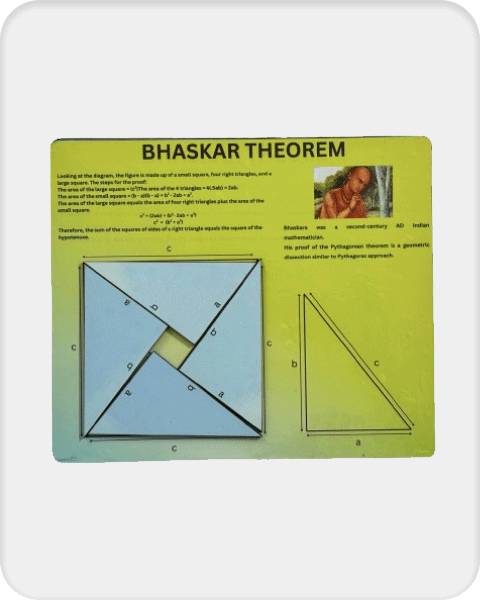
The proof involves two ways of calculating the area of a large square constructed using four identical right triangles and a smaller square.
1. The Construction and Area Postulate
The proof begins by constructing a large square with a side length equal to the sum of the two legs of the right triangle, $a$ and $b$. Thus, the side length is $(a+b)$.
Area Postulate: The area of a composite figure is the sum of the areas of its non-overlapping parts.1
The total area of this large square, $A_{\text{total}}$, is axiomatically defined as:
2. Method 1: Dissected Area (The Inner Square)
The large square is dissected into five pieces:
Four identical right triangles (legs $a$ and $b$, hypotenuse $c$).
One smaller inner square (side length $c$).
The area of each piece is calculated:
Area of one right triangle: 2$\frac{1}{2}ab$
Area of the four right triangles: 3$4 \times \frac{1}{2}ab = 2ab$
Area of the inner square (formed by the hypotenuses): $c^2$
Applying the Area Postulate, the total area is the sum of these parts:
3. Method 2: Algebraic Expansion (The Binomial Square)
The algebraic theory of the Square of a Binomial provides a second expression for the total area $(a+b)^2$:
Geometrically, this is equivalent to rearranging the parts of the large square into:
A square with area $a^2$ (a square based on leg $a$).
A square with area $b^2$ (a square based on leg $b$).
Two rectangles, each with area $ab$, which combine to $2ab$.
Therefore, the total area can also be expressed as:
4. Conclusion: Equating the Areas
Since both expressions $(*)$ and $(**)$ represent the area of the exact same geometric figure, they must be mathematically equal by the Transitive Property of Equality.
By subtracting the shared term ($2ab$) from both sides of the equation, the identity is reduced to the Pythagorean Theorem:
This proof is theoretically significant because it elegantly connects the principles of Euclidean geometry (area calculation) with algebraic identities (the binomial expansion), demonstrating the theorem’s validity through a purely visual and logical deduction.
This video provides an animated visual breakdown of Bhaskara’s geometric proof. Pythagorean Theorem VIII (Bhāskara’s visual proof)